

Greenhouse gas emissions (GHGE) must be considered in relation to the amount of human dietary nutrients produced to optimise the combination of environmental impact while seeking to adequately nourish the global population.
As the proportions and amount of critical nutrients vary widely across foods, a nutrient density measure per unit of GHGE is advocated to make valid comparisons of the environmental impact of alternative diets.
In considering GHG emissions (GHGE) related to animal sourced human food production a pertinent issue is the emissions generated per nutritional unit produced. This is essential to optimise the balance between providing nutrition for an expanding global population while improving environmental outcomes, with implications for both extensive and intensive production systems.
In high output production systems, often intensive, gross emissions are generally lower per unit of nutritional output reflecting a greater proportion of feed intake being utilised in growth or milk output relative to body maintenance. These systems may rely on “imported” emissions from purchased feed grown elsewhere and create further emissions from manure handling and mechanised production. While emissions per animal may be high, emissions per unit of food nutrients produced is generally at the low end of the scale.
In low output systems, such as those applicable to many LMIC situations, low production reduces the % of feed intake that is used for growth or milk production resulting in a higher emissions to nutrient output relationship. Contrasting examples would be milk production for USA and Indian dairy cattle. Whereas USA dairy cattle produce an average of 10,091 kg of milk/cow/year the Indian average is 1,134 kg/cow/year, resulting in 9 times the amount of methane produced per kg of milk. The FAO graph below illustrates the increasing % of feed intake utilised in milk production, and decreasing % absorbed in maintenance, as yield increases.
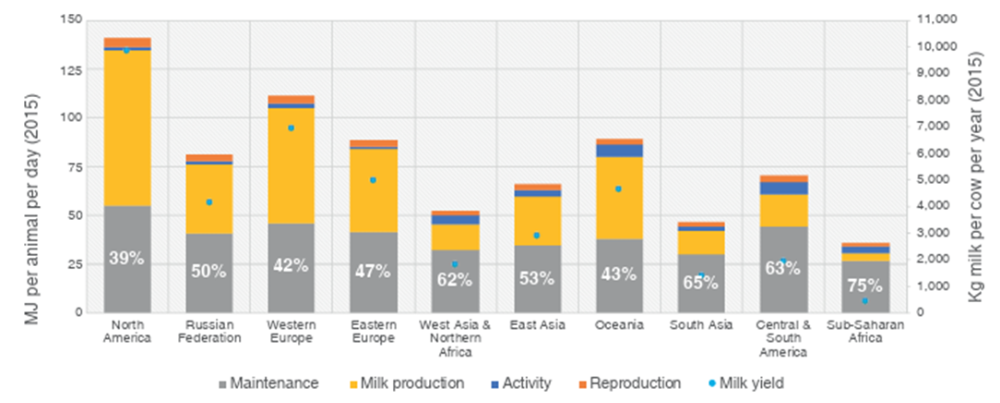
Higher productivity also enables a lesser number of livestock to produce a given quantity of food, and for meat production, harvesting at a younger age, with both changes reducing lifetime emissions relative to human nutrition output. To produce accurate life cycle analyses (LCA) GHGE allocation of the dam’s (mother’s) emissions must also be included and aligned with nutrients delivered directly through milk, meat from the progeny, and the dam herself when leaving the herd.
Net emissions from both extensive and intensive systems vary widely and can be greatly influenced by management. Use of biodigesters and land application of solid wastes can lead to low or negative net emissions from intensive systems whereas management of grazing, and grazing integrated with crop production and manure application, can both improve animal output and soil health leading to additional carbon sequestration and net negative emissions from extensive systems.
Ruminant meat and milk are of very high nutritional quality and bioavailability making comparisons on a unit weight basis misleading when used to compare plant-based food sources. This can be further exaggerated if supply chain losses are not accounted for due to the far higher percentage loss in many plant-based foods. A number of alternative measures of nutrient density have been advocated including simply weight of product (which fails to adjust for nutritional value), weight of protein, kcal of energy or weightings for multiple nutrients.
In principal, calculation on a total diet basis is more useful due to the relative % of different nutrients varying widely between individual diet components but being accumulated, and ideally balanced, in the diet as consumed.
