

Livestock productivity and GHG emissions per unit of output are both impacted by animal genetics and health. The genetic potential for meat and milk production varies widely, as does the selection to suit myriad environments.
To optimise GHG emissions per unit of human food produced genetic selection must enable the highest productivity within specific local management and environmental constraints. Healthy animals are critical to productivity with evidence linking both low and high level disease to greatly increased GHG emissions.
Animal adaption to regional environments is essential for efficient production. Selection of genetics at and within breed and multibreed level must relate to the local climate, land type, feed sources and seasonality in addition to physical facilities and management intensity. These constraints in turn identify required genetic trait priorities and prospective market options.
A key parameter is to match the livestock to the available feed supply; extreme performance stock will require high quality unrestricted feed to deliver their genetic potential and may have difficulty breeding or surviving if placed in a tough environment better suited to a smaller earlier maturing animal with lower maintenance requirements and reduced growth potential. Similarly, resistance to ticks and parasites or the ability to walk long distances will be primary breeding objectives in other environments.
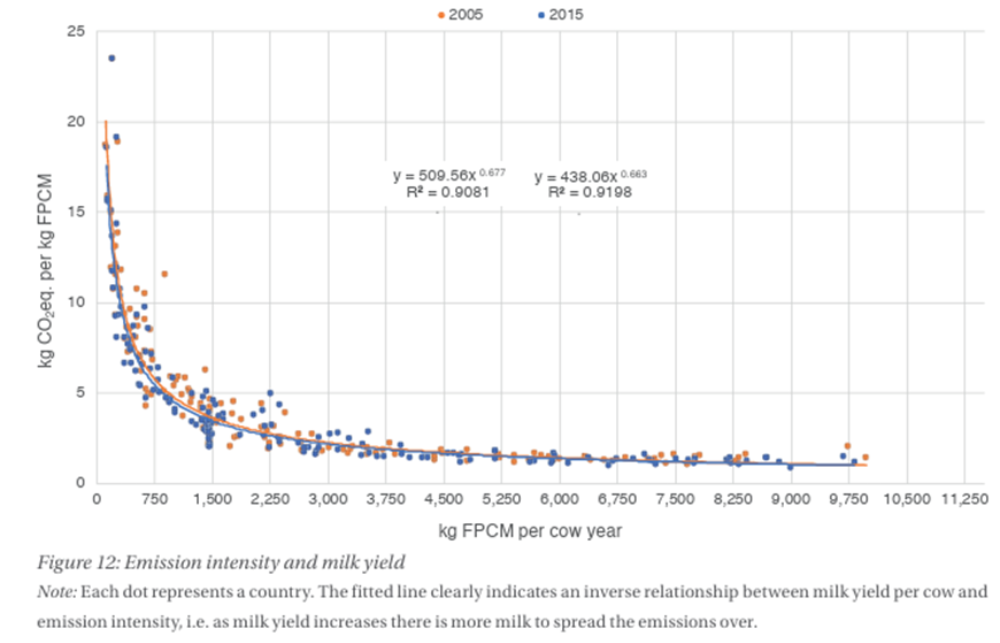
Within these local restraints higher productivity from genetic improvement and associated management is inversely related to GHG emissions intensity, as seen in the FAO graph depicting global milk production by country in 2005 and 2015. The reported change is encouraging with an 11% decline in GHG/kg of milk over this period.
Genetic improvement has a proven track record of productivity enhancements, and following implementation, genetic improvement is permanent and cumulative. New technologies introduced over time, including herd recording and prediction systems, artificial insemination, embryo transfer, sexed semen and gene editing, have each accelerated the rate of genetic gain.
Animal disease and health problems also have a major, and often unappreciated, impact on GHG emissions through reduced productivity. While serious disease or injuries that result, or are likely to result, in death are obvious, background issues with internal parasites, micronutrient deficiencies, reproductive issues, lameness and respiratory conditions such as Bovine Viral Diarrhoea virus (BVD) can draw less attention but reduce production with a related significant increase in GHG per unit of output that can persist over an extended period.
The adoption of cost-effective, genetic, feed, and nutri¬tion practices, and improving livestock health in LMIC are seen as one of the most promising interventions to reduce emissions resulting from projected increased de¬mand for animal-source food through 2050.
