

While carbon dioxide and methane monopolise most GHG discussion, many other gases also contribute, with nitrous oxide (N2O) important in agricultural systems.
The direct warming effect differs radically between gases as does their lifespan with the combination determining their long-term impact. Agriculture, land use and land use change accounts for about 25% of global GHG emissions, with agriculture about half but varying widely by gas, contributing an estimated 14% of CO2, 41% of NH4 and 69% of N2O.
While carbon dioxide (CO2) and methane (CH4) account for the vast majority of greenhouse gas discussion nitrous oxide (N2O) and fluorinated gases (F-gases) comprising hydrofluorocarbons (HFCs), perfluorocarbons (PFCs), sulphur hexafluoride (SF6) as well as nitrogen trifluoride (NF3) are also of importance, together with chlorofluorocarbons (CFCs) and hydrochlorofluorocarbons (HCFCs) that also have considerable warming impacts. The considerable differences in global warming potential (GWP or radiative forcing) reflect both the direct immediate effect of adding a gas to the atmosphere and its life span determining its relative effect over time.
As the reporting benchmark, CO2 is assigned a value of 1 with other gases assigned relative values, CH4 being 29.8 for fossil and 27 for non-fossil methane and N2O being 273. The relative lifespans of each gas also differ with CO2 having an atmospheric lifespan of thousands of years relative to N2O with a lifespan of about109 years and CH4 about 12. The following table displays potential GWP of gases relative to CO2 over 20, 100 and 500 year timeframes, illustrating the extreme diversity from a GWP of 1 to 32,600 over a 500 year period and lifetimes from 3 to 50,000 years.
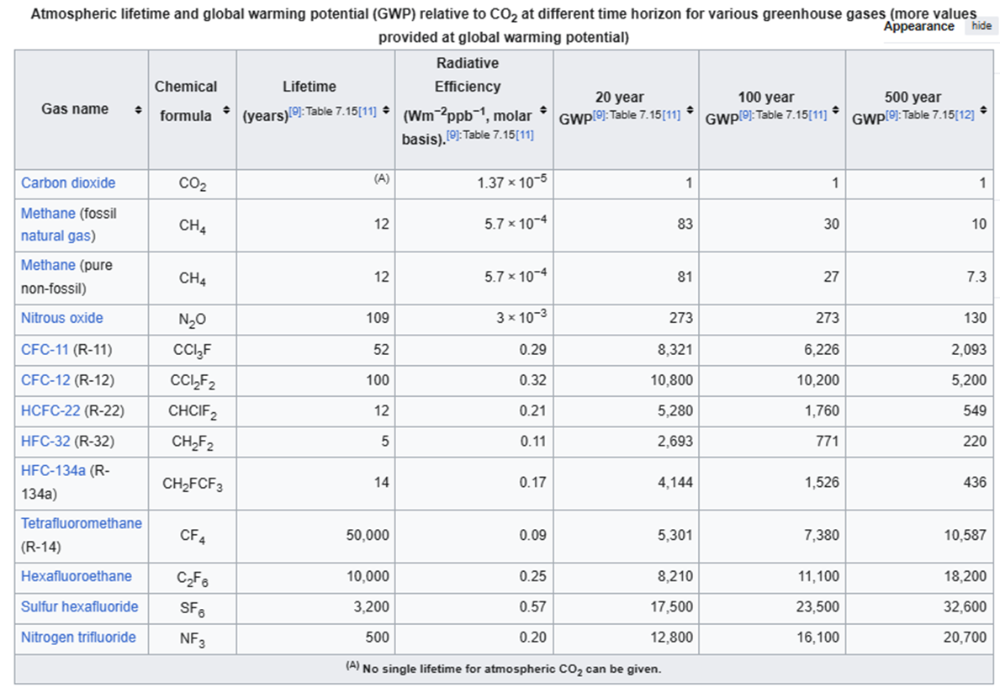
Source: Wikipedia Estimates of GWP values over 20, 100 and 500 years from the IPCC Sixth Assessment Report (2023)
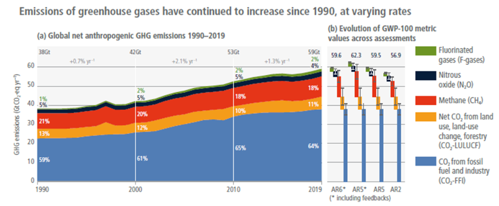
The IPCC sixth assessment estimates of the relative global emissions in CO2 equivalents of CO2, NH4 and N2O are shown in Table 2.1 and the related graph over different time periods.
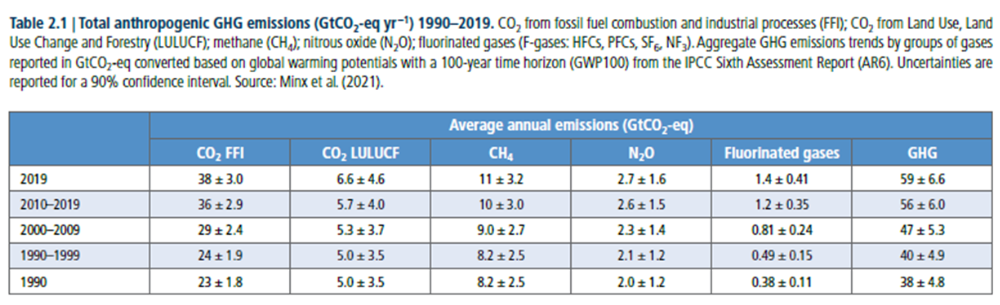
Source: FAO Working Group III contribution to the Sixth Assessment Report
The relative GHG contribution of CO2 from fossil fuels and industry relative to all other sources underlines the critical importance of developing and adopting alternative technologies to reduce these emissions.
Agricultural emissions reduction relates more to methane and nitrous oxide management approaches that can reduce net radiative forcing and differ greatly from the industrial challenge of reducing addition of ancient carbon to the atmosphere. Agricultural practices directly influence, and are influenced by, current natural biological cycles and interactions of soil, water, plant, animal and atmospheric systems. Management approaches built from an understanding of these systems can radically impact climate impact, providing scalable potential to reduce global warming.
The IPCC sixth assessment notes “that the land sector, commonly referred to as ‘agriculture, forestry, and other land uses’ (AFOLU) is responsible for 10–12 GtCO2e (about 25%) of net anthropogenic greenhouse gas (GHG) emissions, with approximately half from agriculture and half from land use, land-use change and forestry (LULUCF).
LULUCF emissions represent the net balance between emissions from land-use change and carbon sequestration from the regeneration of vegetation and soils. Although the AFOLU sector generates considerable emissions, the residual terrestrial sink (accumulation of carbon in the terrestrial biosphere excluding land sinks from LULUCF) also currently sequesters about 30% of annual anthropogenic emissions, making land vitally important for generating ‘negative emissions’ — that is, more carbon dioxide removals (CDR) than emissions.
In addition to GHG impacts, land-use generates biophysical impacts that affect the climate by altering water and energy fluxes between the land and the atmosphere. Furthermore, the AFOLU system provides important ecosystem goods and services such as air and water filtration, nutrient cycling, habitat for biodiversity, and climate resilience.
Agricultural emissions contribute an estimated 21% of GHG but vary widely by gas accounting for an estimated 14% of CO2, 41% of NH4 and 69% of N2O. Agricultural nitrous oxide emissions include direct and indirect emissions related to atmospheric deposition and nitrogen leaching and runoff with N2O emissions including urine and dung deposited during grazing or within confined systems, crop residues returned to the soil, and application of nitrogen fertilizers.
The efficient utilisation of manure and urine, both in natural grazing systems and mechanical management of confined animal systems waste in crop and pasture production, can directly offset synthetic nitrogen and other fertilizer use.
Synthetic fertiliser production has a substantial environmental cost with further atmospheric emissions during application to soils and crops. These losses can be extreme but greatly reduced by best practice management and associated machinery.
Similarly the climate impact of physical collection, storage and application of animal manures from dairies, feedlots and monogastric systems can vary widely, with poor management representing both negative climate impact and waste of valuable resources for improved spoil health and productivity, or through bioenergy generation.
Grazing management also impacts the efficient utilisation of manure directly impacting soil health, plant growth, carbon sequestration and below ground biodiversity through nutrient addition and effective soil incorporation through trampling and disturbance. The efficiency of incorporation is also impacted by dung beetles and other insects, soil microbes and fungi, further underlining the interaction of complex natural systems.
