

The utilisation of fossil fuels including coal, gas and petroleum products differs greatly from biogenic methane. Whereas fossil fuels add net carbon to the atmosphere’s carbon burden, where it can remain and accumulate for up to 1,000 years, biogenic methane arises from recent biological recycling through photosynthesis.
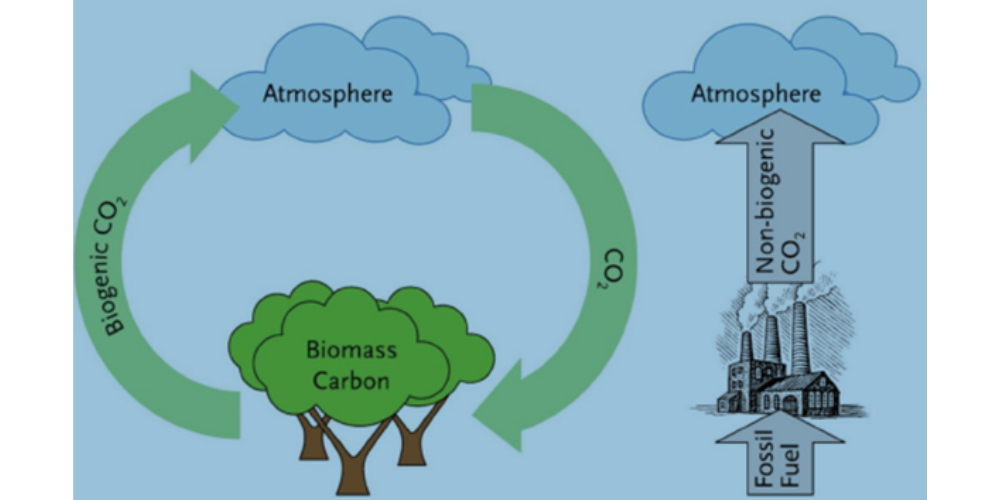
Biogenic carbon keeps recycling among bio-systems and the atmosphere, while the carbon from fossil fuel is a “net” addition to the atmosphere as simply portrayed in the image below.
© Copyright IEA Bioenergy 2025. All rights reserved. Website managed by ETA-Florence Renewable Energies
Carbon atoms entering the atmosphere from recent biological processes (mainly as CO2 and CH4 from things like landfills, rice paddies, livestock - and breathing humans!) are essentially recycled carbon atoms, operating in a type of “closed-loop” biological carbon cycle.
This is because the carbon atoms all derive from carbohydrate that was recently produced by photosynthesis. That’s why, for example, the Kyoto Protocol accorded burning biomass fuels as “carbon neutral” at the point of combustion. In contrast, carbon atoms entering the atmosphere from burning or venting fossil fuels have not featured in the world’s active carbon cycle for millions of years. As such they represent “new” carbon added to a system that was, until relatively-recently, in equilibrium.
In fact, scientists can distinguish between fossil-derived carbon and biogenic carbon through isotopic fractionation via C14 measurements to independently quantify and verify the biogenic and fossil carbon fractions of fuels.
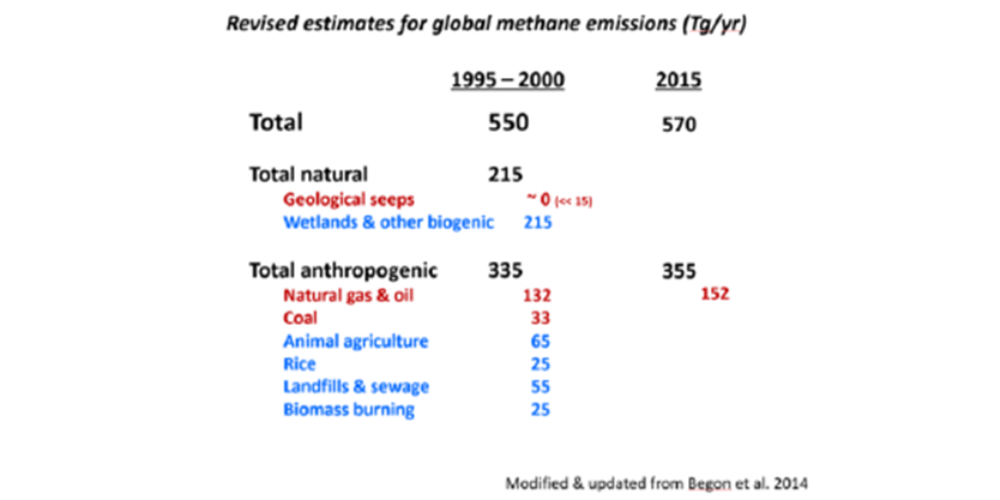
Ice core data utilising the C14 methodology, presented at COP 23 in 2017, suggests that prior estimates of biogenic methane were overestimated relative to fossil fuel sources. It was concluded that half of all human-caused methane emissions in the late 20th century came from fossil fuel use, with the other half coming from animal agriculture, rice agriculture, sewage treatment plants, landfills, and biomass burning combined.
The increase in fossil fuel methane emissions coincided with the explosion in shale gas and shale oil development in the United States. Several high visibility papers published in 2016 used the C13 stable carbon isotopic composition of atmospheric methane to infer what is driving changes in methane emissions over time. Two of these, published in Science and Nature concluded that increased methane emissions over the past decade were likely caused by animal agriculture, particularly emissions from cows and cattle.
One potential problem with these studies based on C13 in atmospheric methane is their failure to explicitly consider shale gas separately from conventional natural gas leading the author to tentatively conclude the shift in atmospheric methane C13 that was attributed to cows may in fact have been from shale gas emissions. Based on this finding it was estimated that methane emissions from the oil and gas industry are now likely more than 2-times larger than those from all animal agriculture globally as summarised in the figure below.
Growth in anthropogenic emissions has persisted across all major groups of GHGs since 1990, albeit at different rates. By 2019, the largest growth in absolute emissions occurred in CO2 from fossil fuels and industry followed by CH4 with the IPCC noting that CO2 emissions from land use, land-use change and forestry (CO2-LULUCF) are subject to large uncertainties and high annual variability.
While some references advocate reducing livestock numbers, particularly of ruminants, and reforesting or cropping of pasture land to reduce methane emissions, these are countered by evidence that these emissions can be reduced by new feed additives, increased productivity and capture for energy generation in intensive operations and by sequestration of soil organic carbon in grazing systems where sequestered carbon greatly exceeds that emitted.
In summary, greenhouse gas emissions from well-managed livestock operations represents natural carbon recycling and is therefore not adding to atmospheric carbon whereas, in contrast, burning ancient fossil fuels is increasing the total burden of carbon in today’s atmosphere.
