

Finding ways to reduce livestock’s contribution to climate heating is now prominent in global climate policy. Using technology to reduce methane from ruminant animals is one avenue.
At the same time, farmlands have the capacity to remove atmospheric CO2 in growing vegetation and regenerative soil management. The path to net zero emissions in livestock depends on achieving a balance between direct GHG reductions and compensatory removals.
Methane emissions from ruminant livestock account for 68 percent of agriculture’s greenhouse gas (GHG) emissions globally, when measured in 100-year warming terms (GWP100). That said, when considering methane emissions per se, complications arise with adopting the GWP100 metric because methane breaks down in the atmosphere after about 12 years.
Notwithstanding this complication, plus the continuing debate around the different climate impacts of “biogenic” and “fossil-derived methane”, significant global climate policy is nevertheless directed at reducing livestock methane.
Ruminant livestock process plant material in their rumen into short fatty acids such as acetate, propionate and butyrate, and CO2 and methane gas (the latter due mainly to an excess of acetate over propionate in the animal gut). While the fatty acids are absorbed and metabolized by the animals, the gases escape via belching / burping. As well as adding these GHGs to the atmosphere, this process “sacrifices” up to 12% of the gross energy content of the feedstock.
So, while enteric methane production is a normal aspect of ruminant, these emissions can be said to represent a loss of productivity, as carbon is directed to the atmosphere rather than into animal growth and nutrition. For example, MLA has calculated that “… the average cow emits 50-90kg of methane per year, equivalent to 33-60 grazing days lost a year…”.
Accordingly, a large amount of research and practice is underway to find ways to reduced enteric methane generation in cattle.
“Net zero emissions” refers to the end state of a strategy pathway where direct GHG emissions are as close to zero as possible, with any remaining emissions removed from the atmosphere by nature-based sequestration and / or other engineering means. Net zero emissions are thereby achieved when anthropogenic emissions of GHGs to the atmosphere are balanced by anthropogenic removals over a specified period.
The “net” part recognises a role for offsetting and insetting emissions effects along the product supply chain. This is because not all emissions reductions will occur directly at the emissions source, with reductions outside of high-emitting sectors and industry, especially through nature-based sinks and mitigations, will have an important role in supporting urgent near and medium-term targets.
Achieving net zero livestock emissions requires adopting a mix of:
- technical solutions such as animal feed-mix optimisation
- use of methane-inhibiting feed additives such as Asparagopsis or 3NOP
- reducing the overall emissions intensity of livestock herds by, for example, increasing the herd’s ratio of weight to age, reducing the proportion of unproductive animals in the herd, or changing the ratio of livestock classes within the herd to increase total annual live weight gain of the herd
- sowing pasture species known to reduce methane production in grazing livestock (such as Desmanthus and Leucaena)
- employing anerobic digestors to minimize manure sourced emissions
- direct methane capture (and emerging technology)
- genetic improvements in livestock metabolism, including gene editing
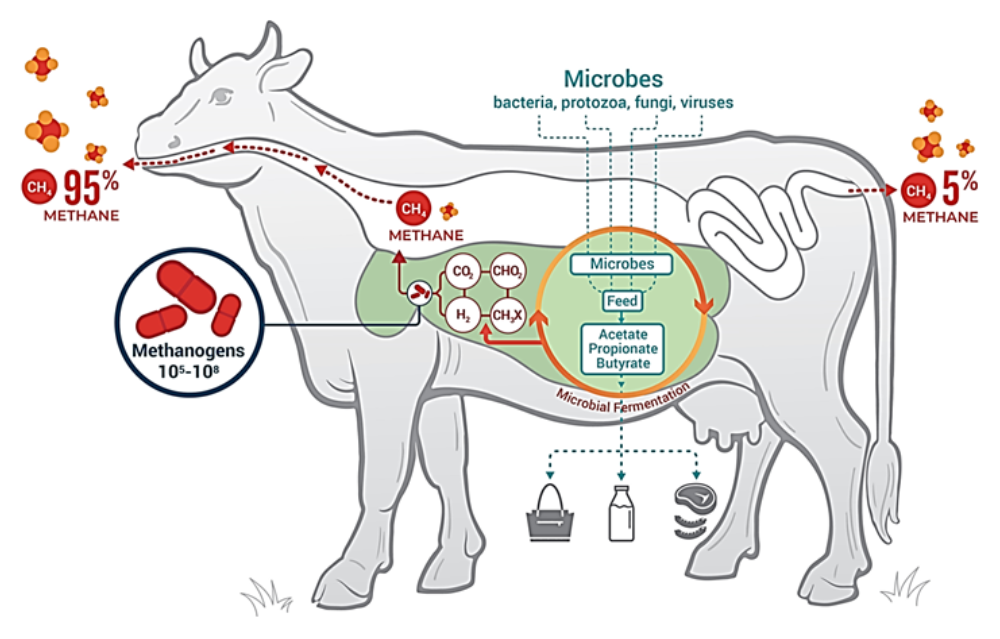
Source: Glasson et al. 2022. Benefits and risks of including the bromoform containing seaweed Asparagopsis in feed for the reduction of methane production from ruminants. Algal Research 64: 102673
