
Regenerative grazing systems actively maintain pasture vegetation cover, encourage pasture species diversity, and provide adequate pasture rest between grazing events.
These systems are shown to efficiently steward the landscape’s natural capital (such as soil health, nutrient supply, soil water-holding capacity, and biodiversity conservation). They also sustain build net soil carbon stocks over time.
Regenerative grazing systems have gained prominence over recent years with growing attention to climate change impacts and concern that traditional practices may not be sustainable financially, given input costs in relation to yields and commodity pricing, and ecologically due to reduced soil health, biodiversity and water system function with each associated with more erratic and extreme weather events.
An early innovator and developer of regenerative grazing, referred to as Holistic Management, was Alan Savory who adopted observed grazing practices of wild African game to domesticated stock. Holistic Management is based on a key insight that properly-managed ruminant animals are vital to overall ecosystem health, and hold the power to sequester carbon, build soil, enhance biodiversity, and restore degraded ecosystem health (Savoury Institute). These principles have been adopted by many directly and with some adaption by other extension parties in many countries including those in Africa, South America, the USA and Australia.
At a basic level the core principle is that soil health, biodiversity and output can be dramatically increased over a moderate period by well controlled grazing and without use of synthetic fertilizer. Livestock are grazed at high density for short periods and then rotated through other grazing areas with the intense grazing causing all plants to be reduced rather than more attractive species selectively eaten. This in turn favours expansion of better species, usually a diverse mix featuring a higher proportion of deeper-rooted perennials and increased plant growth leading to greater soil biological activity, improved structure and water holding capacity.
The manure deposited also adds organic matter to accelerate the process with the trampling assisting in soil incorporation. Managed or rotational grazing that includes deep-rooted multi-species perennial pasture plants is most effective at building sol organic carbon, particularly at depth. On-farm studies in Australia and New Zealand show it’s operationally feasible to achieve annual soil carbon sequestration rates of between 1.3 and 4.8 tonnes of CO2-e per hectare through managed grazing in permanent pastures.
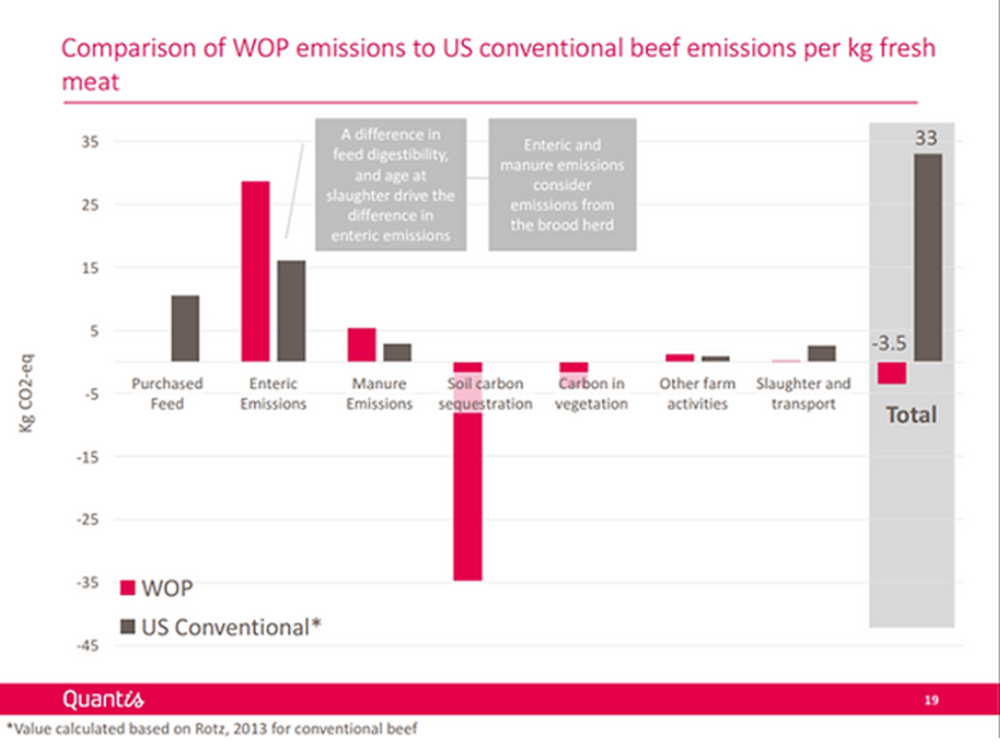
These practices have also been shown to substantially build new soil, and provide increased livestock output within a reduced input cost regime as demonstrated in the figure below from White Oak Pastures’ Beef, life cycle analysis (LCA).